A major study presented at ESCMID Global 2026 has found that antiretroviral therapy (ART) reduces accelerated biological aging in people with HIV (PWH) by nearly four years, a finding that could transform how clinicians monitor HIV treatment and long-term health outcomes.
Researchers developed a plasma proteomic aging clock (PAC)—a tool that estimates biological age, reflecting physiological aging rather than chronological age—using patterns across hundreds of blood proteins. The model was applied to participants in the Swiss HIV Cohort Study (SHCS).
The PAC was trained on 941 plasma samples from PWH receiving successful ART and then evaluated in an independent cohort of 80 participants who contributed 294 longitudinal samples spanning viremic pre-ART infection (when HIV was detectable in the blood) and suppressive post-ART phases.
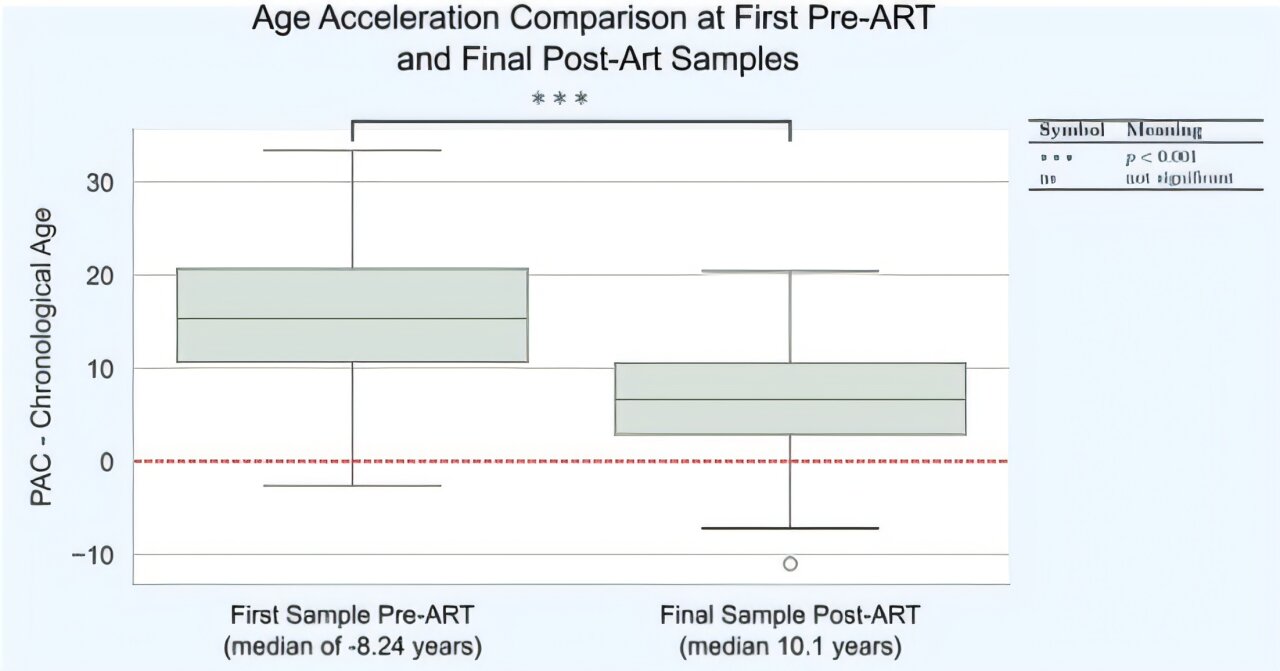
During untreated HIV infection, the PAC estimated that participants’ biological age was accelerated by a median of 10 years. After a median duration of 1.55 years of ART, researchers observed a statistically significant mean reduction of 3.7 years in proteomic age (95% CI 2.7 to 4.7; p = 0.0001).
Trajectory analyses showed that proteomic age continued to move closer to chronological age with longer ART exposure, suggesting ongoing biological recovery with sustained treatment.
Previous research suggests that PWH may experience accelerated biological aging, which is linked to chronic inflammation and a higher risk of age-related conditions including coronary disease, underscoring the clinical urgency of these findings.
“This research demonstrates the importance of early start and optimal adherence to ART,” commented lead study author Dr. Barry Ryan, a postdoctoral researcher at EPFL, Switzerland.
“We’re extremely fortunate to have a unique group from the SHCS who had samples collected for up to eight years before they started ART. With this group, we have measured the effect of untreated HIV infection and successful ART on telomere shortening, epigenetic aging and now proteomic aging. In each case, we have shown that uncontrolled HIV infection is linked to faster aging and that ART significantly slows this.”
The PAC primarily captures changes in inflammatory signaling and drug metabolomic pathways. When compared with the team’s previously published epigenetic aging clock (EAC) in the same cohort, both clocks showed similar overall trends.
However, the PAC was more sensitive to short-term immune changes, showing a faster increase during untreated infection and a more rapid decline once detectable HIV in the blood (viremia) was suppressed with ART.
Importantly, the reversal of proteomic age acceleration after ART was not significantly associated with CD4+ or CD8+ T-cell count recovery, suggesting that the reversal reflects broader inflammatory and innate immune remodeling rather than T-cell reconstitution alone.
“Our findings support the current consensus for starting ART promptly after HIV diagnosis,” explained Dr. Ryan. “The participants were closely monitored pre-ART, including CD4 and CD8 T-cell counts. Nonetheless, we observed accelerated proteomic aging irrespective of T-cell homeostasis, with acceleration already occurring nearest the time of HIV diagnosis.”
The authors call for external validation of the PAC in more diverse global populations and for proteome-wide feature attribution studies to pinpoint the specific pathways driving HIV-related aging biology.
“While specific pathways of reversal may vary by ancestry and population, the global trend of accelerated aging with untreated HIV and its attenuation after virological suppression is likely to generalize,” Dr. Ryan added.
More information
Ryan, B., et al. A plasma proteomic aging clock reflects reversal of accelerated aging in people with HIV under antiretroviral therapy. Oral presentation. ESCMID Global 2026.
Key medical concepts
Provided by
European Society of Clinical Microbiology and Infectious Diseases
Citation:
HIV treatment reduces accelerated biological aging by nearly four years, landmark study shows (2026, April 19)
retrieved 19 April 2026
from https://medicalxpress.com/news/2026-04-hiv-treatment-biological-aging-years.html
This document is subject to copyright. Apart from any fair dealing for the purpose of private study or research, no
part may be reproduced without the written permission. The content is provided for information purposes only.

